
Brass: Lancashire
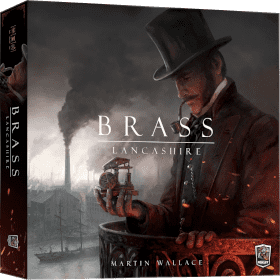 Brass: Lancashire – ursprünglich unter dem Titel „Brass“ veröffentlicht – ist ein Wirtschaftsstrategiespiel, das die Geschichte konkurrierender Baumwollunternehmer in Lancashire während der Industriellen Revolution erzählt. Die Spielenden müssen ihre Industrieanlagen und ihr Verkehrsnetz entwickeln, errichten und etablieren, um von der Nachfrage nach Eisen, Kohle und Baumwolle zu profitieren. Das Spiel erstreckt sich über zwei Hälften: die Kanalphase und die Eisenbahnphase. Ziel des Spiels ist es, die meisten Siegpunkte zu sammeln, die jeweils am Ende einer Phase gewertet werden. Siegpunkte erhält man durch Kanäle, Eisenbahnstrecken sowie etablierte (umgedrehte) Industrieplättchen. In jeder Runde sind die Spielenden gemäß der Zugreihenfolge an der Reihe und haben jeweils zwei Aktionen zur Verfügung, um eine der folgenden Möglichkeiten zu nutzen: ein Industrieplättchen errichten, eine Eisenbahnstrecke oder einen Kanal bauen, einen Industriezweig weiterentwickeln, Baumwolle verkaufen oder einen Kredit aufnehmen
Am Ende deines Zuges ersetzt du die beiden Karten, die du ausgespielt hast, durch zwei neue Karten vom Nachziehstapel. Die Zugreihenfolge wird dadurch bestimmt, wie viel Geld die Spielenden im vorangegangenen Zug ausgegeben haben – wer am wenigsten ausgegeben hat, ist zuerst an der Reihe. Dieser Mechanismus der Zugreihenfolge eröffnet Spielenden, die später an der Reihe sind, strategische Optionen und ermöglicht unter Umständen sogar zwei aufeinanderfolgende Spielzüge.
Nachdem alle Karten einmal ausgespielt wurden (wobei die Anzahl der Karten im Stapel an die Zahl der Spielenden angepasst wird), endet die Kanalphase und eine Wertungsrunde beginnt. Im Anschluss an die Wertung werden alle Kanäle sowie sämtliche Industrieanlagen der niedrigsten Stufe aus dem Spiel genommen; danach werden neue Karten ausgeteilt und die Eisenbahnphase beginnt. Während dieser Phase können die Spielenden nun mehr als einen Standort innerhalb einer Stadt besetzen, und es ist möglich, Doppelverbindungen zu errichten (auch wenn dies kostspielig ist). Am Ende der Eisenbahnphase findet eine weitere Wertungsrunde statt, woraufhin die siegreiche Person gekürt wird.
Die Karten schränken ein, wo du Industrieanlagen errichten, Baumwolle verkaufen oder Verbindungen aufbauen kannst (wobei jede Karte auch für eine „Entwicklungs“-Aktion genutzt werden kann). Dies erfordert ein strategisches Timing beim Ausspielen oder Aufbewahren von Karten. Da Ressourcen allgemein zugänglich sind, musst du beim Bau einer Eisenbahnstrecke (für die Kohle benötigt wird) auf die nächstgelegene Quelle zurückgreifen – das kann auch die Kohlemine von Mitspielenden sein. Dadurch rückt diese Mine wiederum näher an die Wertung heran (da sie genutzt wurde).
Spielerzahl: 2 - 4
Spieldauer: 67 mn
Komplexität: 3 / 5
Spiele Brass: Lancashire und 1421 andere Spiele online.
Kein Download notwendig, spiele direkt im Webbrowser.
Mit deinen Freunden und tausenden Spielern aus der ganzen Welt.
Kostenlos.


Spiele Brass: Lancashire und 1421 andere Spiele online.
Kein Download notwendig, spiele direkt im Webbrowser.
Mit deinen Freunden und tausenden Spielern aus der ganzen Welt.
Kostenlos.
Kurzregel
Core Turn Structure On your turn, you must perform exactly 2 actions (Exception: Everyone only takes 1 action during the very first round of the game). For every action you take, you must discard exactly 1 card from your hand. Turn order for the next round is determined by how much money you spend in the current round. The player who spends the least goes first; the player who spends the most goes last.
The 5 Actions You may perform any combination of the following actions, including taking the same action twice:
1. Build: Place an industry tile on the board.
Location Card: Build any industry in the matching city (does not need to be connected to your network).
Industry Card: Build the matching industry in any city that is part of your established network.
Cost: You must pay the money on the tile, plus any required Coal or Iron.
2. Network: Expand your connections.
Canal Era: Place 1 canal for £3.
Rail Era: Place 1 rail for £5 + 1 Coal, OR place 2 rails for £15 + 2 Coal.
Rule: New links must connect to a location already in your network.
3. Develop: Discard 1 or 2 of the lowest-level industry tiles from your player board to access higher-level, more profitable tiles.
Cost: 1 Iron per tile removed.
4. Sell: Flip your un-flipped Cotton Mills to increase your income and prepare them for scoring.
Must be connected to an un-flipped Port (yours or an opponent's) OR connected to the Distant Market.
You can sell from multiple mills in a single action.
5. Loan: Take an immediate cash injection of £10, £20, or £30 from the bank.
Penalty: Your income track drops by 1, 2, or 3 color-band levels.
Restriction: You cannot take loans during the final 4 rounds of the Rail Era.
The Golden Rule of Resources - Understanding how resources move is the key to winning Brass:
1. Coal needs a path: To use Coal, your build site must be physically connected (via any player's canals/rails) to an unexhausted Coal Mine or a Port with a trade icon. You must always consume the closest available coal.
2. Iron teleports: Iron does not require network connections. You can use Iron from any unexhausted Iron Works on the board, regardless of where it is.
3. If no resources are on the board, you may buy them from the global market, provided you have the required network connection for Coal (Iron can always be bought from the market).
Era Transition & Scoring - Scoring occurs at the end of both the Canal Era and the Rail Era.
Network Links: Score 1 VP for every gold link symbol on the two location tiles connected to your canal/rail.
Flipped Industries: Score the VP value printed on all of your flipped industry tiles.
Between Eras:
1. All Level 1 industry tiles are permanently removed from the board.
2. All Canal links are removed.
3. Level 2+ industries remain on the board and will score again at the end of the Rail Era.
BGA-Specific Tips for Playing
Undo is your friend: Brass is a highly calculable game. Use the "Undo" button on BGA to test a sequence of actions (especially double-rail placements or double-develops) to ensure you have exactly enough money and resources before committing.