
Unangenehme Gäste
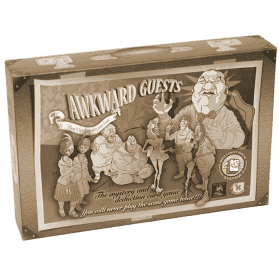 "Unangenehme Gäste" ist ein einzigartiges Rätselspiel mit unendlichem Wiederspielwert. Man kann den Mord an Mr. Walton auf so viele verschiedene Arten nachstellen, dass keine zwei Partien jemals gleich verlaufen! (Mr. Walton wird euch dafür allerdings nicht dankbar sein.)
Das Spiel fordert dich heraus, echte detektivische Fähigkeiten einzusetzen, um jeden Fall zu lösen. Um ein Rätsel zu lösen, musst du die Verdächtigen verhören, das Hauspersonal befragen, den Tatort untersuchen, in der Walton-Villa nach Hinweisen suchen und die Polizeiberichte durchsehen. All dies tust du, während du Informationen mit deinen Gegnern austauschst oder sie vor ihnen verheimlichst – also mach dich bereit, all deine detektivischen Fähigkeiten einzusetzen!
WER hat Mr. Walton getötet?
WIE hat der Mörder ihm das Leben genommen?
WARUM hat der Mörder ihn getötet?
Gab es einen KOMPLIZEN?
Das Spielprinzip von „Unangenehme Gäste“ ist einfach: Die Spieler halten sechs Karten auf der Hand, wobei jede Karte einen Wert (1, 2 oder 3 Punkte, je nach Umfang der darin enthaltenen Informationen) und mehrere Referenzen (d. h. die Themen der Karteninformationen) aufweist. In einem Zug fragst du nach Informationen zu zwei verschiedenen Referenzen, die dich interessieren. Die übrigen Spieler können dir Karten anbieten, die die gewünschten Referenzen enthalten, und du kannst diese Karten eintauschen, indem du über Karten aus deiner Hand den anbietenden Spielern die gleiche Anzahl an Punkten gibst, die sie angeboten haben.
Nach jeder Runde können die Spieler versuchen, das Rätsel zu lösen. Wird das Rätsel nicht gelöst, werfen die Spieler einen Teil ihrer Handkarten ab und erhalten drei neue Karten. Wer zuerst das Rätsel löst, gewinnt.
Spielerzahl: 1 - 8
Spieldauer: 18 mn
Komplexität: 2 / 5
Spiele Unangenehme Gäste und 1378 andere Spiele online.
Kein Download notwendig, spiele direkt im Webbrowser.
Mit deinen Freunden und tausenden Spielern aus der ganzen Welt.
Kostenlos.


Spiele Unangenehme Gäste und 1378 andere Spiele online.
Kein Download notwendig, spiele direkt im Webbrowser.
Mit deinen Freunden und tausenden Spielern aus der ganzen Welt.
Kostenlos.
Kurzregel
Awkward Guests: The Walton Case
This is a deduction and information-trading game. All players try to solve the murder on Mr. Walton. The first player to do so correctly, wins the game.
Each player has their own investigation sheet (private to them) to keep track of the information they learn during the game.
Goal
Be the first player to correctly solve the case by identifying:
- - WHO killed Mr. Walton?
- - WHY did they kill him (motive)?
- - HOW did they put an end to his life (weapon)?
- - Was there an ACCOMPLICE and, if so, WHO and WHY?
(For Beginner / Very Easy / Easy cases there is never an accomplice.)
Information in the game
Each card has:
- - an information value (1–3), representing the amount of valuable information, and used to price exchanges;
- - references (suspects and/or rooms) showing what the info is about;
- - the case-related information;
- - how the information can be denoted on the tracking sheet.
Round structure
The game is played in rounds. In each round, every player takes one turn (anti-clockwise). Each turn has 3 phases:
- - Inquiry Phase
- - Offer Phase
- - Exchange Phase
After all players have taken a turn, the round ends with a Solution Phase. If no one has solved the murder in this phase, the game continues with the Discard Phase.
Your turn
1. Inquiry Phase (ask for 2 references)
On your turn, you must request information about exactly 2 different references:
- - suspects (the 6 guests), and/or
- - rooms in the mansion.
So you may ask for: 2 suspects, 2 rooms, or 1 suspect and 1 room. Arrows are used to show all players which 2 references have been chosen.
2. Offer Phase (others offer relevant cards)
Starting with the player to your right and continuing anti-clockwise, each other player may prepare an offer:
- - They may offer any number of cards from their hand, or choose not to offer any cards at all;
- - Every offered card must contain at least one of the references you requested.
- - The offered cards are placed face down and a marker with the offer value (the sum of information values in the offer (1–3 per card)) is placed on top of it.
Offers are final once declared.
3. Exchange Phase (you choose and pay)
After all offers are made, you choose whether to exchange and with whom:
- - You may exchange with as many players as you want this turn;
- - For each chosen offer, give that player cards from your hand (any references allowed) totalling at least the offer value.
- - Exchanges are always for the full offered value. You cannot negotiate for part of an offer.
All chosen exchanges are executed and players add received cards to their hands.
If no one makes an offer, instead draw 3 cards (if possible), and your turn ends.
End of the round
Solution Phase (everyone decides at once)
All players still in the game simultaneously choose:
- - Solve now, or
- - Continue investigating.
Players who choose to solve determine their full accusation:
- - murderer;
- - motive;
- - weapon;
- - plus accomplice + accomplice motive (if they believe there is one).
(Recall that for Beginner / Very Easy / Easy cases there is never an accomplice.)
Then each solving player checks against the official solution (on BGA this is handled automatically, following the app rules).
If a player is completely correct, the game ends and they win;
If a player is wrong, they are not eliminated.
- - As a penalty, that player is NOT allowed to participate in the Solution Phase of the next round.
- - Neither their guess nor the correct solution is revealed.
Discard Phase (if continuing)
All remaining players discard down to 3 cards in hand.
Then the starting player marker passes to the player on the right, and the new starting player deals cards to refill everyone's hands back up to 6 cards (as far as possible). A new round begins.
If the game deck runs out
When the draw deck is empty:
- - The discard pile is shuffled to form a new deck;
- - The top 3 cards are revealed face up for everyone to examine, then placed into the revealed pile;
- - The rest of the pile is used as the new draw deck.
Useful rules for deduction
- - The police/coroner/housekeeper/service staff do not lie.
- - The innocent guests do not lie regarding who they were with at the time of the murder.
- - The Berwick Sisters count as 2 guests but move and act as 1.
What the different card topics usually tell you
- - Alibi info: where suspects claim to be at the time of the murder (only certain rooms are valid alibi rooms). If two suspects claim to be together (and vice versa), then either both are innocent, or they are the murderer and the accomplice.
- - Motive info: supports or dismisses possible motives. If all three motives of a suspect are dismissed, that suspect is innocent.
- - Conspiracy info: hints about possible accomplices. If there is an accomplice, staff will always find them conspiring, but some conspiracies can be red herrings. The accomplice only helps by giving an alibi (same room at murder time) and does not reveal the murderer's motive (and vice versa).
- - Weapon info: each weapon leaves two signs; missing either sign dismisses the weapon. The Study (crime scene) references often eliminate many weapons.
- - Opportunity/Movement info: who could reach the Study, and which rooms the murderer could have passed through. If a suspect cannot reach the Study via allowed routes, they cannot be the murderer.
2-player differences
Play according to the rules above, with these changes:
- - Inquiry Phase: request information about 4 different references instead of 2 (any mix of suspects/rooms).
- - Exchange Phase: cards you receive are not kept. Both players look at received cards, take notes, then immediately discard them.
- - If the active player receives no offer, they draw 2 cards, take notes, then immediately discard those cards.
Solo mode
Play according to the rules above, with these changes:
- - Setup: You are assigned a starting score based on the difficulty level chosen.
- - Inquiry Phase: no change
- - Offer Phase: You will be offered up to 3 card/point combos related to the references chosen, and 1 card, worth 1 point, that is not restricted to the references.
- - Exchange Phase: Points will be deducted based on the offer chosen. Prior cards in hand will be discarded.
- - Solution Phase: An incorrect guess does not end the game, however it does disqualify you from guessing in the next round.
- - Goal: Find the correct solution with points remaining.